Niagara Falls sits atop a complex sequence of glacial lake sediments, with the Halton Till and glaciolacustrine clays dominating the near-surface geology. The city’s 43.1°N latitude means seasonal freeze-thaw cycles penetrate up to 1.2 meters deep, altering soil structure each winter. For any excavation deeper than a basement, knowing the Atterberg limits is not optional—it defines how the clay will behave when wet. A liquid limit above 50% combined with a plasticity index exceeding 30 signals a highly plastic CH clay that will shrink and swell with moisture fluctuation. In the Drummondville neighborhood, we have seen these clays lose bearing capacity after spring thaw, leading to differential settlement. A grain-size analysis of the fine fraction helps confirm clay mineralogy, while a Proctor test establishes the compaction curve for engineered fill.
A plasticity index above 30 in the glaciolacustrine clays of Niagara Falls is a direct indicator of high shrink-swell potential that must be addressed in slab-on-grade and shallow footing design.
Methodology and scope
Local considerations
The freeze-thaw cycles in Niagara Falls create a unique risk for plastic clays. When ice lenses form in a CH clay with a high plasticity index, the soil can heave 50 to 100 mm in a single winter. Spring melt saturates the desiccated crust, and the undrained shear strength can drop by 40% in three weeks. Slabs poured directly on this material crack at the edges first, then propagate across the floor. The liquidity index, derived from Atterberg limits and natural water content, predicts this sensitivity. An LI approaching 1.0 means the clay behaves as a viscous fluid under load. The team has mapped zones near the Niagara Glen where the laminated clays exhibit LI values above 0.8 in April. Deep footings must extend below the active zone, or the soil must be chemically stabilized with lime to reduce plasticity. Ignoring the Atterberg limits in this climate is a direct path to structural distress within the first five years.
Explanatory video
Applicable standards
ASTM D4318-17e1, ASTM D2487-17e1, CSA A23.3-14, Ontario Building Code (OBC) Section 4.2
Associated technical services
Liquid and Plastic Limit Determination
Full multipoint liquid limit per ASTM D4318 with plastic limit by hand-rolling. Includes natural water content, flow curve, and classification on the plasticity chart.
Shrinkage Limit Test
Determines the water content below which no further volume reduction occurs. Essential for assessing desiccation cracking potential in clay liners and covers.
Activity and Mineralogy Correlation
Combines Atterberg limits with hydrometer analysis to compute activity (A = PI / % clay). High activity (>1.25) indicates smectite presence and extreme swell risk.
Lime Stabilization Pre-Testing
Before and after Atterberg limits on lime-treated specimens to quantify plasticity reduction. Used to design soil improvement for subgrades and embankments.
Typical parameters
Frequently asked questions
How much do Atterberg limits tests cost in Niagara Falls?
The Atterberg limits test (liquid limit and plastic limit) on a single sample typically runs between CA$90 and CA$120, depending on whether the one-point or full multipoint method is required. A full suite with natural water content, grain-size distribution, and USCS classification is priced per sample set. Contact the lab for volume pricing on projects with more than ten samples.
What is the difference between liquid limit and plastic limit?
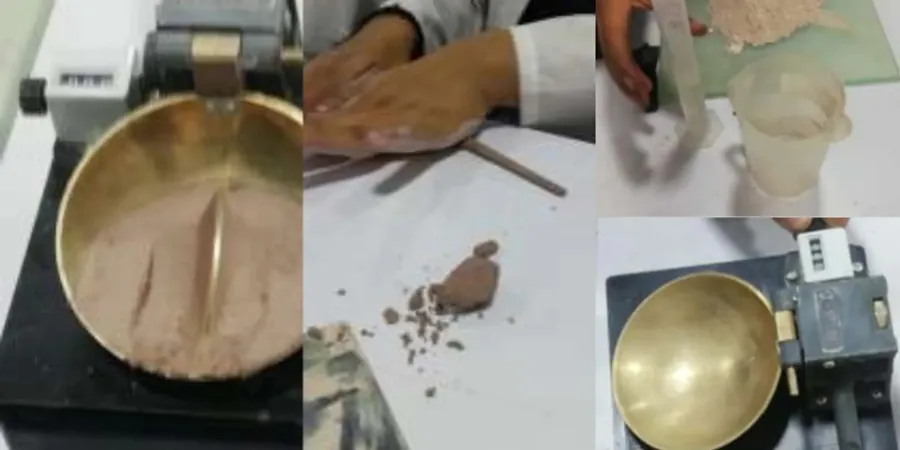
The liquid limit is the water content at which a soil transitions from plastic to liquid behavior, measured using the Casagrande cup per ASTM D4318. The plastic limit is the water content at which the soil crumbles when rolled into a 3.2 mm thread. The plasticity index is the numerical difference between the two, and it quantifies the range of water content over which the soil remains plastic.
Why do Atterberg limits matter for foundations in Niagara Falls?
The glaciolacustrine clays in the Niagara region can have plasticity indices above 30, which indicates high shrink-swell potential. Seasonal moisture changes from freeze-thaw cycles cause these clays to expand and contract, stressing shallow foundations. The Atterberg limits classify the soil and predict this behavior so footings can be designed below the active zone or the soil can be stabilized.
How many samples are needed for a reliable Atterberg limits profile?
At minimum, one sample per distinct soil layer encountered in the borehole or test pit. For a typical Niagara Falls residential site with 2–3 meters of clay overburden, that usually means 2–3 samples. For a commercial excavation extending into the laminated clay unit, we recommend sampling every 1.5 meters. The ASTM standard requires the test be run on material passing the No. 40 (425 µm) sieve.