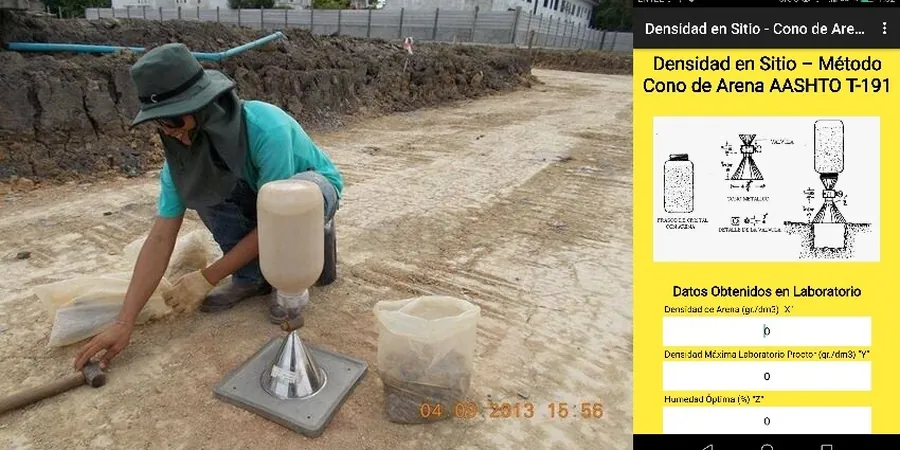
The glacial till and lacustrine clays underlying much of the Niagara Peninsula present a challenging profile for earthworks contractors, and nowhere is this more apparent than in Niagara Falls Ontario. The city sits atop the Halton Till—a dense mixture of silty clay with embedded boulders—overlain by pockets of sandy silt from the former Lake Iroquois shoreline. When placing engineered fill for a commercial foundation near Montrose Road, the difference between 95% and 92% Standard Proctor density can determine whether differential settlement cracks appear in the first winter freeze-thaw cycle. Our team runs the ASTM D1556 sand cone test directly on the lift, providing a number the site superintendent can act on within minutes, not days. For deep excavations in the clay plain, we often pair density testing with Atterberg limits to confirm that moisture content is within the specified range before compaction begins.
Compaction is cheap insurance: a single failed density test caught during backfill saves more than a future underpinning repair.
Methodology and scope
Local considerations
Ontario Regulation 332/12 under the Building Code Act requires compaction testing as part of the geotechnical review for engineered fill placement, and in Niagara Falls Ontario the stakes are amplified by the region's seismic category. Though moderate, the seismic hazard in the Niagara area—coupled with the sensitive Leda-type clays found in isolated pockets near the escarpment—means that poorly compacted backfill against basement walls can lose strength during ground shaking, leading to lateral spreading. We have investigated foundation distress in the Chippawa district where settlement of utility trench backfill, compacted without density verification, pulled service connections apart within three years of construction. A field density test using the sand cone method costs far less than excavating and replacing settled fill after landscaping and paving are complete.
Applicable standards
ASTM D1556-15e1: Standard Test Method for Density and Unit Weight of Soil in Place by Sand-Cone Method, AASHTO T-191: Density of Soil In-Place by the Sand-Cone Method, OPSS 501: Compacting (Ontario Provincial Standard Specification)
Associated technical services
Compaction Verification for Structural Fill
Sand cone testing on building pads, foundation backfill, and retaining wall drainage layers, reported as percent of laboratory maximum dry density per ASTM D698 or D1557.
Road Base and Subgrade Density Testing
In-place density checks on Granular A and Granular B road base materials, following OPSS 1010 specifications for municipal and MTO road projects in the Niagara region.
Utility Trench Backfill Testing
Compaction verification in trench zones (bedding, cover, and backfill) per OPSD 802 drawings, with density results provided for each lift before paving restoration.
Typical parameters
Frequently asked questions
What does a sand cone field density test cost in Niagara Falls Ontario?
For sites in Niagara Falls Ontario, a single visit with three sand cone density points typically runs between CA$120 and CA$230 per point, depending on access conditions and whether laboratory Proctor data is already available. Sites requiring multiple lifts tested on the same day can reduce the per-point rate.
How soon can you mobilize a technician for compaction testing?
We can usually have a field technician on site in Niagara Falls within 24 to 48 hours of your call, assuming the laboratory Proctor reference value is already established. If a new Proctor is needed, we expedite the lab work and aim for a three-day total turnaround.