Foundation engineering in Niagara Falls, Ontario, must contend with the region’s complex glacial stratigraphy—interbedded clays, silts, and till overlying fractured shale and limestone of the Niagara Escarpment. Proximity to the gorge and buried bedrock valleys can produce abrupt changes in bearing capacity and groundwater regimes, requiring designs that meet the Ontario Building Code’s limit states for frost protection, seismic resilience, and serviceability on sensitive soils. Deep foundation solutions, such as pile foundation design, are frequently specified where near‑surface soils exhibit low strength or high compressibility.
This category supports residential additions on marginal fill, commercial buildings near the escarpment face, and municipal infrastructure within the city’s flood‑prone corridors. Site‑specific pile foundation design accounts for downdrag from consolidating clay and lateral loads imposed by wind or ice. For shallow rock conditions, supplementary ground improvement or underpinning methods may be integrated to optimize performance while respecting strict environmental controls governing the Niagara River watershed.
In the Queenston Formation, a passive anchor grouted into intact shale can mobilize three times the bond capacity of one in the weathered top zone — field proof test data confirms it.
Methodology and scope
Local considerations
NBCC 2020 and CSA A23.3 set the baseline for anchor design in Canada, but in Niagara Falls the karst geology raises the bar. The Lockport dolomite has solution-widened joints and occasional open cavities that can swallow grout with no warning. We have seen single anchors take over 400 liters of grout when the borehole intersected a karst feature. That is not just a cost risk. It is a capacity risk. The bond zone you assumed in the design may not exist where you think it does. We water-test every borehole at low pressure before grouting. If the take exceeds 5 L/min at 0.1 MPa, we pre-grout and redrill. For passive anchors in the Queenston shale, the bigger threat is long-term relaxation. The shale swells when it gets wet. That can reduce the confining stress and drop the bond capacity over a freeze-thaw cycle. We specify a minimum cover of 2 meters of competent rock over the bond zone on the gorge side to mitigate that.
Applicable standards
CSA A23.3-19 — Design of Concrete Structures (Annex D: Anchors), NBCC 2020 — National Building Code of Canada, ASTM C1741 — Standard Test Method for Bleeding Stability of Cement Grout, PTI DC35.1-14 — Recommendations for Prestressed Rock and Soil Anchors, OPSS.MUNI 206 — Ontario Provincial Standard for Rock Anchors
Associated technical services
Active anchor design and proof testing
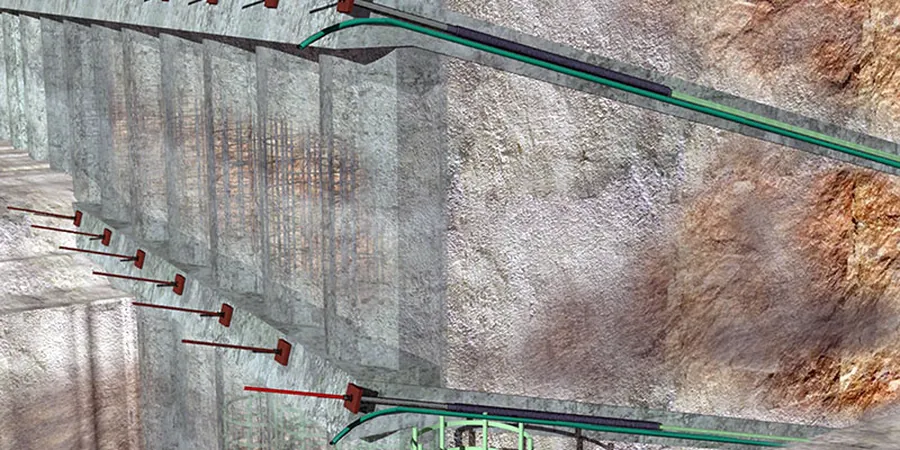
We design tieback anchors for deep excavations, bridge abutments, and retaining walls where movement must be controlled. The package includes the bond length calculation in layered rock, the corrosion protection system per PTI Class I, and the on-site proof test program. We use hollow-stem auger or rotary duplex drilling depending on the overburden and rock quality designation.
Passive anchor and rock dowel design
For rock slope stabilization along the Niagara Escarpment and tunnel portal support, we design fully grouted passive anchors and rock dowels. We determine the pull-out capacity from in-situ bond tests in the Queenston shale and Lockport dolomite, then verify the load distribution with strain gauges on select anchors.
Typical parameters
Frequently asked questions
What is the cost range for an anchor design and testing program in Niagara Falls?
A complete scope — site investigation, anchor design calculations, preparation of a proof test procedure, and on-site supervision of the test program — runs between CA$1,460 and CA$4,690 depending on the number of anchors and the complexity of the rock profile. A single-anchor proof test report with calibrated jack and digital readout falls at the lower end. A full program with multiple anchor types in karstic dolostone and swelling shale will be at the upper end.
How do you verify the bond capacity in the fractured dolostone caprock?
We run a sacrificial anchor test program. We grout a test anchor in the same orientation and rock layer as the production anchors, then pull it to failure. The failure mode tells us if the bond stress is controlled by the grout-rock interface or the grout-steel interface. We back-calculate the ultimate bond stress and apply a factor of safety of 2.0 to 2.5, which matches the Ontario Ministry of Transportation standard.
Why do some anchors lose load over time in the Queenston shale?
The Queenston Formation is a weak, clay-rich shale with a high swelling potential. When the borehole exposes the shale to water from the grout or from perched aquifers, the rock expands and then relaxes as the pore pressure dissipates. That relaxation reduces the radial confinement on the grout column, and the anchor load drops. We account for this by specifying a longer bond length and by performing lift-off tests at 14 and 28 days after lock-off to measure the seated load.