A commercial plaza near Lundy's Lane needed parking lot replacement after only eight years. Joint spalling and corner breaks everywhere. The original design used a generic Ontario specification without accounting for Niagara's specific frost penetration depth. We see this pattern often across the region. Rigid pavement design demands more than a standard cross-section. It requires understanding the local silty clay subgrades and the relentless freeze-thaw action that comes off the Niagara Escarpment. Our team brings that local knowledge to every CBR road investigation and rigid pavement design project. We also integrate flexible pavement analysis when comparing life-cycle costs for municipal tenders.
In Niagara Falls, joint design dictates pavement life. Get the spacing wrong and you'll have blow-ups by the third winter.
Methodology and scope
Local considerations
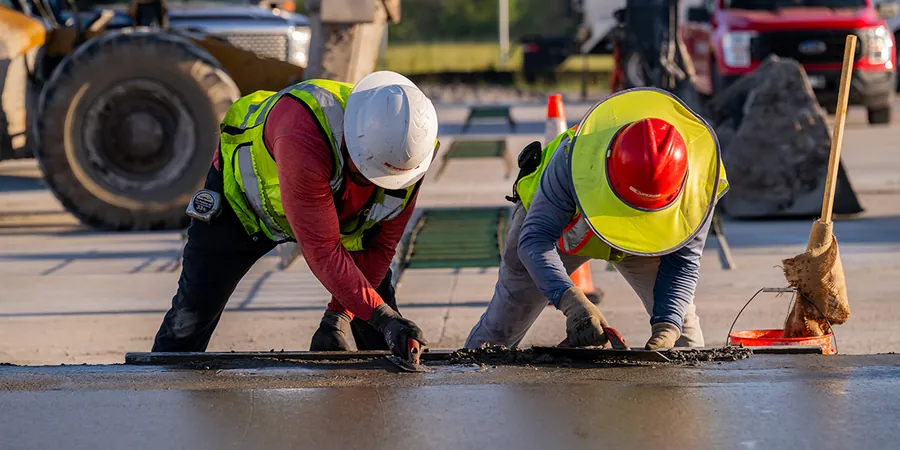
A slipform paver moves along Stanley Avenue at 2 meters per minute. Behind it, the concrete is still plastic. The finishers work fast. If the subgrade k-value varies by more than 15% across the paving width, differential curling stresses appear within the first year. We've measured k-values below 20 MPa/m in the saturated clays near the Welland River floodplain. That's half what some designers assume. Undershooting the slab thickness by just 20 mm in those conditions cuts the design life from 30 years to under 12. Our pre-paving investigation always includes plate load testing at 50-meter intervals. We also check for soft spots with dynamic cone penetration. No assumptions. Just data.
Applicable standards
CSA A23.1:19/A23.2:19 – Concrete materials and methods of concrete construction, ASTM D1196/D1196M-21 – Standard Test Method for Nonrepetitive Static Plate Load Tests of Soils and Flexible Pavement Components, ACPA – Guide for Design of Jointed Concrete Pavements (TB010P), OPSS 350 – Concrete Pavement (Ontario Provincial Standard Specification), MTO Pavement Design and Rehabilitation Manual (2013)
Associated technical services
Subgrade Evaluation and k-value Testing
Plate load testing per ASTM D1196 to determine the modulus of subgrade reaction. We test at multiple locations to capture variability in Niagara's lacustrine clay deposits.
Pavement Thickness Design
Design using PCA and ACPA methods calibrated for Ontario axle loads. We model the specific traffic spectrum expected, from delivery trucks to transit buses on regional roads.
Joint Layout and Reinforcement Detailing
Contraction joint spacing, dowel bar sizing, and tie bar placement. All details account for the 50-degree annual temperature swing typical of the Niagara Peninsula.
Concrete Mix Design Review
Specification of air-entrained mixes for exposure class C-2. We review aggregate sources, supplementary cementitious materials, and set maximum w/cm ratios for durability.
Typical parameters
Frequently asked questions
What thickness of rigid pavement do I need for a parking lot in Niagara Falls?
For typical passenger vehicle parking lots with occasional truck access, we design 150 mm to 175 mm slabs on 150 mm of Granular A. Heavy truck routes or loading docks require 200 mm minimum. The final thickness depends on the subgrade k-value from plate load testing and the expected traffic loading over the design life.
How much does rigid pavement design cost for a project in Niagara Falls?
A full design package including subgrade investigation, thickness design, joint detailing, and mix specification typically ranges from CA$2,870 to CA$8,110 depending on project size and testing requirements. Small commercial sites fall at the lower end. Municipal roadways with multiple test sections and traffic analysis reach the upper range.
How do freeze-thaw cycles affect concrete pavement in Niagara?
Niagara Falls experiences 40 to 60 freeze-thaw cycles per winter. Without proper air entrainment and low water-cement ratio, water in the capillary pores freezes and expands, causing surface scaling and internal cracking. We specify air contents of 5% to 8% and a maximum w/cm of 0.45 per CSA A23.1 exposure class C-2.
What joint spacing do you recommend for Ontario's climate?
We follow ACPA guidelines adapted for southern Ontario. For 150 mm slabs, transverse contraction joints at 3.6 m to 4.0 m spacing. For 200 mm slabs, up to 4.5 m. The ratio of slab length to radius of relative stiffness is kept below 8.0 to prevent mid-panel cracking. Dowel bars at all transverse joints for slabs over 175 mm.