A common mistake we see around Niagara Falls is treating a deep excavation like a generic Ontario cut-and-cover job. The overburden here is deceptive—glacial till and lacustrine clay can sit directly on fractured Queenston Shale or limestone, and the groundwater table often follows the Escarpment’s natural drainage toward the gorge. When a contractor digs below the design grade without verifying the bedrock profile, they can trigger a sudden inflow that overwhelms sump pumps in minutes. We design support systems that account for these transitions using site-specific data rather than regional defaults. For projects near the Niagara Parkway or within the Fallsview district, where adjacent heritage structures limit allowable movement, we integrate excavation monitoring with the shoring design so the field team gets real-time feedback on wall deflection before it becomes a problem.
In Niagara Falls, the biggest risk in a deep excavation is not the depth—it’s the variable rockhead and groundwater perched above fractured shale.
Methodology and scope
Local considerations
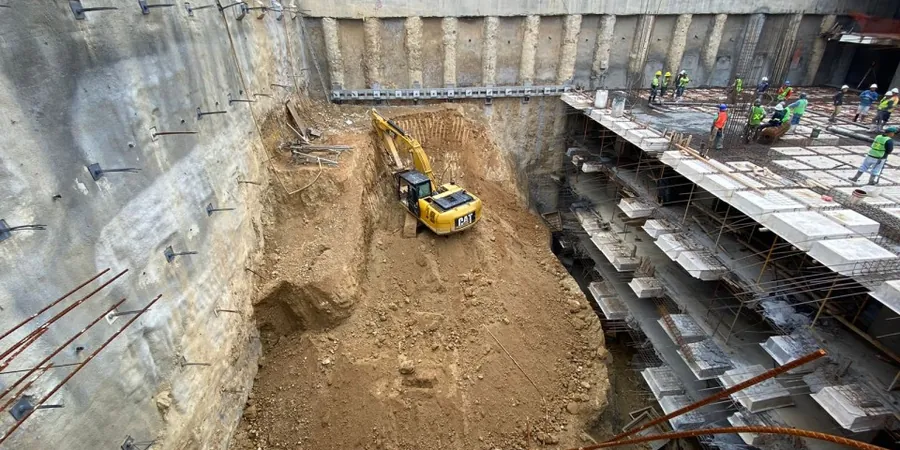
A twelve-storey hotel project on Fallsview Boulevard required a 14-metre excavation within eight metres of a 1920s masonry theatre. The original tender assumed full-depth bedrock at minus six metres, but our supplemental investigation found a buried valley filled with soft clay extending to minus seventeen metres. Without redesign, the cantilever soldier pile wall would have deflected over 60 millimetres at the crest, likely cracking the theatre’s east wall. We switched to a top-down diaphragm wall with two levels of preloaded tiebacks anchored into competent shale below the valley. The shoring performance stayed under 12 millimetres of lateral movement throughout construction. That project illustrates why deep excavation design in Niagara Falls cannot rely on regional geological maps alone—the local buried topography drives the cost, the schedule, and the risk to adjacent structures.
Applicable standards
NBCC 2020 Part 4 – Structural Design, CSA A23.3:19 – Design of Concrete Structures, CSA Z107.56 – Vibration and Noise from Construction, ASTM D7012 – Uniaxial Compressive Strength of Rock, FHWA Geotechnical Engineering Circular No. 4 – Ground Anchors and Anchored Systems
Associated technical services
Shoring Wall Design & Staged Excavation Plans
Seismic earth pressure analysis per NBCC 2020, tieback spacing optimization, and staged cut sequences that respect the actual bedrock surface and seasonal groundwater levels encountered in Niagara Peninsula soils.
Base Stability & Groundwater Control
Evaluation of heave, piping, and basal uplift in excavations penetrating fractured shale aquifers. Design of temporary dewatering systems, cut-off walls, or grout curtains where the Escarpment recharge feeds high artesian pressure.
Third-Party Peer Review & Instrumentation Specification
Independent design check for municipalities and developers. We specify inclinometer arrays, piezometer nests, and crack monitors integrated with construction-phase review against predicted wall deflection envelopes.
Typical parameters
Frequently asked questions
How much does a deep excavation design cost for a Niagara Falls project?
Professional fees for a site-specific deep excavation design typically range from CA$3,230 to CA$10,250 depending on excavation depth, number of shoring levels, and complexity of the ground model. A straightforward 6-metre cut in competent rock with a single tieback level falls at the lower end, while a 20-metre urban excavation requiring staged analysis, groundwater modelling, and instrumentation specifications moves toward the upper end. We provide a fixed-fee proposal after reviewing the geotechnical baseline report and architectural drawings.
What geotechnical data do you need before starting the design?
We need borehole logs with SPT N-values and rock quality designation (RQD), laboratory strength tests on soil and rock samples, and piezometer readings covering at least one seasonal cycle. If the excavation is deeper than 10 metres near the Escarpment, we also request in-situ stress measurements or pressuremeter data because the horizontal stress in Queenston Shale can exceed the vertical overburden stress and influence wall behaviour.
Do you handle the Ministry of Labour trench safety requirements?
Yes. Our designs comply with Ontario Regulation 213/91 for construction projects, including the requirements for professional engineer-designed support systems when excavations exceed 3 metres in depth or when workers must enter the excavation. We provide stamped shoring drawings and a written opinion on structural adequacy for the constructor’s site package.
Can you design an excavation that avoids damaging the Ontario Power Generation tunnels?
Absolutely. Several OPG tunnels and penstocks run beneath the city, and vibration and settlement limits are strict. We coordinate with OPG’s engineering team to define allowable thresholds, then design the shoring stiffness and blasting sequences—if rock removal is needed—to stay within those criteria. Instrumentation is mandatory on these projects, and we specify automated monitoring with daily reporting during critical excavation phases.