A common misstep in the Niagara area is treating retaining wall design as a standardized, off-the-shelf solution without accounting for the Queenston Shale or the steep piezometric gradients near the escarpment. We regularly see post-construction distress—bulging, tilting, or water bleed-through—that traces back to ignoring the stiff, fissured clay layers that dominate the Haldimand clay plain. Our laboratory anchors every project in site-specific data, extracting undisturbed Shelby tube samples and running triaxial shear tests to feed real strength parameters into the wall analysis. When cut slopes expose gravelly lenses from the former Lake Iroquois shoreline, we switch to in-situ test pits to map the stratigraphy directly, because no desktop model captures the erratic cobble pockets that can throw off a soldier pile alignment. These field checks, combined with laboratory confirmation of friction angles, keep retaining structures stable through the freeze-thaw cycles that challenge the entire Niagara Peninsula.
A retaining wall in Niagara Falls must handle not just lateral earth pressure but also the relentless freeze-thaw fatigue that opens cracks and invites water behind the stem.
Methodology and scope
Local considerations
Niagara Falls sits at roughly 170 meters above sea level, perched on the edge of a 50-meter-deep gorge carved through the Lockport Dolostone; this topographic drop creates a permanent hydraulic gradient toward the river that can destabilize any retaining structure not designed for seepage forces. The 2019–2020 high-water levels on Lake Ontario reminded every engineer in the region that groundwater tables can rise quickly, saturating the backfill behind walls along the lower Parkway and the Clifton Hill approaches. When the phreatic surface climbs, the effective stress drops and the lateral thrust can double compared to drained conditions—a reality we address by specifying filter-compatible drainage zones and, in critical cases, incorporating a grouting curtain to cut off preferential flow paths in fractured rock. Frost penetration, which reaches 1.2 meters in an average Niagara winter, adds another layer of risk: ice lens formation in silt-rich backfill can jack a wall stem outward permanently, so our designs always include a non-frost-susceptible granular core and a foundation depth below the local frost line.
Applicable standards
CSA A23.3-19 – Design of Concrete Structures, NBCC 2020 – Part 4 Structural Design (seismic provisions for Site Class C/D), ASTM D3080/D3080M-23 – Direct Shear Test of Soils Under Consolidated Drained Conditions, MTO Retaining Wall Design Manual (provincial supplement for highway walls), OPSS 1010 – Aggregates for drainage and backfill
Associated technical services
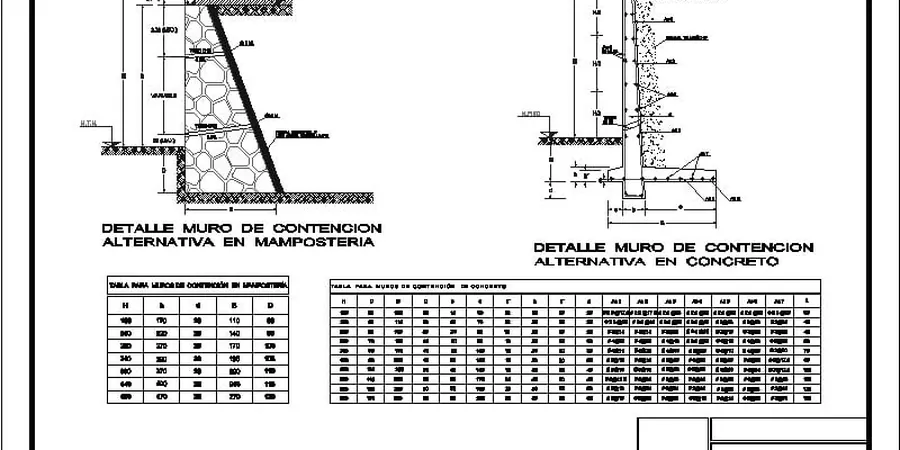
Gravity and cantilever wall analysis
We generate the full pressure envelope—active, at-rest, and passive—using laboratory-derived effective stress parameters. Overturning, sliding, and bearing capacity checks follow the limit states framework of the NBCC, with our team providing the bearing capacity factors verified by footings load tests when required.
MSE wall and soil-nail design
For mechanically stabilized earth walls, we run pullout tests on reinforcement in a calibrated box filled with the project's compacted backfill. Soil-nail designs rely on our in-situ bond stress determination from grouted anchor pullout tests, combined with laboratory grout cube strengths at 7 and 28 days.
Drainage and frost protection design
Our constant-head permeameter tests on candidate backfill materials ensure the drainage blanket meets the 1×10⁻² cm/s threshold. We also perform frost heave susceptibility classification per ASTM D5918, specifying the clean granular chimney drain that keeps pore pressure off the back of the stem through every Niagara winter.
Typical parameters
Frequently asked questions
What is the typical cost range for a retaining wall design package in Niagara Falls, Ontario?
For a residential or light commercial retaining wall design with full laboratory testing, the package typically falls between CA$1,460 and CA$6,060, depending on wall height, number of borings, and whether advanced triaxial or direct shear tests are required.
How deep should the footing be for a retaining wall in this region?
Foundation depth must extend at least 1.2 meters below finished grade to sit beneath the design frost penetration depth for the Niagara area. On sloping sites near the escarpment, we also verify global stability to confirm the footing is not undermined by a deep-seated failure surface passing below the wall.
Which soil parameters do you test to design a retaining wall?
We measure effective cohesion and friction angle via consolidated-drained triaxial or direct shear tests, unit weight from Shelby tube and sand cone density, and the saturated permeability of the backfill. Atterberg limits and grain-size distribution identify frost-susceptible fines that must be excluded from the reinforced zone.
Do you consider the Niagara Gorge proximity in the wall design?
Yes. The steep hydraulic gradient toward the gorge can generate sustained seepage pressures behind the wall. We model the phreatic surface using piezometer readings and, when necessary, design a drainage system or a low-permeability cutoff to prevent internal erosion and hydrostatic overloading of the wall stem.
Can you design a retaining wall on soft clay found near the old Lake Iroquois plain?
Soft glaciolacustrine clay requires a careful bearing capacity assessment and often a global stability analysis using Spencer's method. We run consolidated-undrained triaxial tests to capture the clay's undrained shear strength profile, then design either a reinforced concrete cantilever on a granular pad or a lightweight MSE structure to limit settlement.