Last year we were called out to a commercial site off Montrose Road where an access road kept failing even after two rounds of repaving. The contractor was frustrated, the client was losing patience, and nobody had actually checked what was happening six inches below the asphalt. We pulled undisturbed Shelby tube samples from the silty clay subgrade that dominates the Niagara Falls area and ran a series of laboratory CBR tests under soaked conditions to simulate what really happens during a spring thaw. The numbers told the story clearly enough that the design team switched from a standard flexible section to a stabilized base course with improved drainage. In our experience across the Niagara Region, the laboratory CBR test is the single most practical tool for connecting what the soil can actually carry with what the pavement structure demands. For deeper subgrade evaluation, we often coordinate with grain-size analysis to confirm fines content, or run proctor-tests to establish compaction targets before the CBR specimens are even molded.
A soaked CBR of 3 or less on Niagara silty clay means you are building on a sponge. Ignore that number and the pavement tells you the same thing, just more expensively.
Methodology and scope
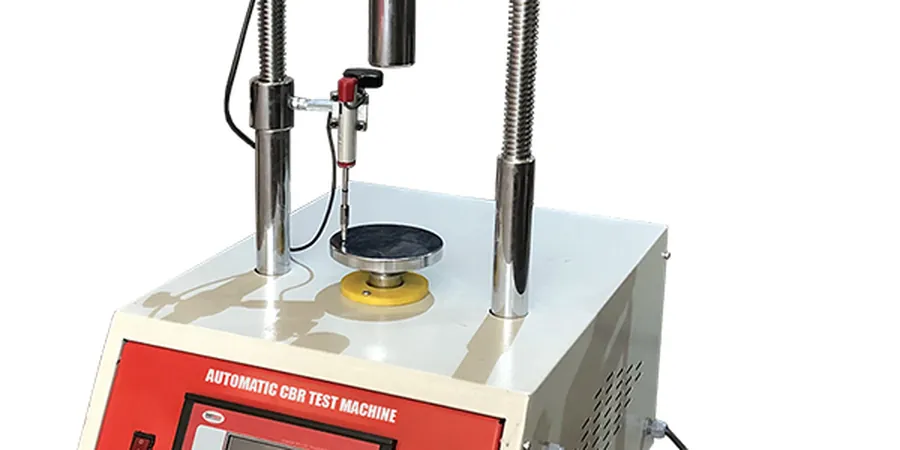
Local considerations
The Niagara Peninsula sits on glaciolacustrine deposits left by Lake Iroquois and the retreating Wisconsin ice sheet, which means the near-surface soils across much of Niagara Falls are laminated silts and lean clays that can hold water like a reservoir. The water table in many parts of the city sits within three to five feet of grade by late March, right when frost is leaving the ground and contractors are eager to start the paving season. A CBR test performed on a sample that has not been properly soaked can overestimate the subgrade support by a factor of two or three, which leads directly to underdesigned pavement sections that rut and crack within the first two winters. We have seen this pattern repeat on Lundy's Lane commercial developments, on municipal road widenings along Thorold Stone Road, and on industrial parking lots in the Montrose business park. The fix is not complicated: specify the soaked CBR, design the pavement structure for the worst-case moisture condition, and install edge drains or subdrains if the CBR falls below 4. When the numbers are tight, we coordinate with flexible-pavement design or cbr-road field correlation to build a complete picture before asphalt goes down.
Applicable standards
ASTM D1883-21 — Standard Test Method for California Bearing Ratio (CBR) of Laboratory-Compacted Soils, ASTM D1557-12e1 — Standard Test Methods for Laboratory Compaction Characteristics of Soil Using Modified Effort, ASTM D422-63(2007)e1 — Standard Test Method for Particle-Size Analysis of Soils, AASHTO T 193-13 — The California Bearing Ratio, MTO Laboratory Testing Manual (LS-700) — Ontario provincial reference for CBR procedures
Associated technical services
Standard Soaked CBR Testing
Three-point compaction curve with CBR specimens molded at optimum moisture content, soaked for 96 hours under surcharge, and penetrated to determine the soaked CBR value at 0.1 and 0.2 inches. Includes swell measurement during soaking and moisture content verification after testing.
Unsoaked (As-Compacted) CBR Testing
For projects where the water table is confirmed deep and subsurface drainage is permanent, we run CBR penetration immediately after compaction without soaking. This applies mainly to well-drained granular subgrades or sites above the Niagara Escarpment where silty clay is absent.
CBR Correlation and Pavement Design Input
We combine laboratory CBR results with grain-size distribution, Atterberg limits, and field compaction data to produce a pavement design subgrade modulus. For Niagara Falls municipal or MTO projects, we structure the output to feed directly into AASHTO 1993 or MTO pavement design software.
Typical parameters
Frequently asked questions
How much does a laboratory CBR test cost in Niagara Falls?
A standard three-point soaked CBR test in our Niagara Falls lab runs between CA$150 and CA$320 per specimen, depending on whether we are running a single point or a full three-point compaction curve with multiple molds. The total project cost depends on how many distinct soil types or lift samples need individual CBR determinations.
How long does it take to get CBR results?
The soaking period alone takes 96 hours, and compaction, setup, and penetration testing add another two to three working days. For a standard three-point soaked CBR, we typically deliver results within seven to eight business days from specimen preparation. Unsoaked CBR can be turned around in three to four days.
What CBR value do I need for a parking lot in Niagara Falls?
For a commercial parking lot with asphalt pavement carrying passenger vehicles and occasional delivery trucks, we typically look for a soaked CBR of at least 5 to 6 in the subgrade. If the CBR comes back at 3 or below, we recommend either excavating and replacing the upper 12 to 18 inches with granular fill, or stabilizing the subgrade with cement or lime before paving.
Is the field CBR the same as the laboratory CBR?
No, and the distinction matters. Field CBR testing uses a portable apparatus pushed directly into the subgrade at the site, which is useful for rapid screening but does not control moisture the way a lab test does. The laboratory CBR test under ASTM D1883 compacts the soil at a known moisture and density, then soaks it under controlled conditions, giving a worst-case design value. We use field CBR for quality control during construction and lab CBR for the actual pavement design.
Can you test CBR on granular materials or only on fine-grained soils?
Both. ASTM D1883 covers fine-grained and granular soils, though for clean gravels we use a larger 6-inch mold and modified Proctor compaction. In Niagara Falls, most of our CBR work is on silty clay subgrades, but we regularly test Granular A and Granular B base and subbase materials for MTO-specified projects to confirm they meet the required CBR thresholds.