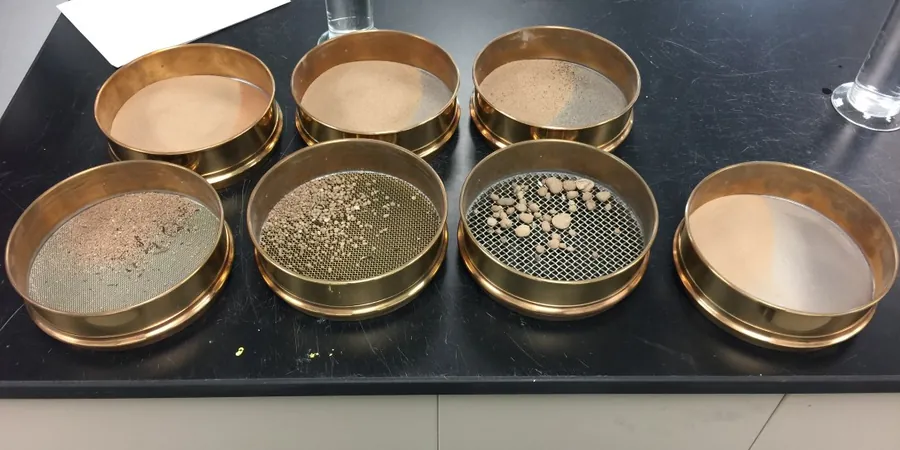
In the Niagara region, the glacial geology tells half the story before you even open a bag of samples. We routinely see Halton Till right next to glaciolacustrine silts, sometimes in the same borehole. A standard grain size analysis that stops at the No. 200 sieve misses critical information about the fine fraction. For Niagara Falls projects, we run the full sieve plus hydrometer suite under ASTM D7928, because the clay-size content controls frost heave potential and drainage behavior in ways that sand percentages alone cannot predict. When silty layers appear near the Niagara Escarpment, we often pair the hydrometer data with Atterberg limits to confirm whether the fines are plastic or non-plastic silts—this distinction determines excavation stability and subgrade treatment requirements across the region.
A complete particle-size distribution, from cobbles to clay colloids, is the single most useful index test for classifying Niagara’s glacial soils and predicting how they will behave under load, water, and freeze-thaw cycles.
Methodology and scope
Local considerations
The Ontario Building Code (OBC) and CSA A23.3 reference grain size data for seismic site classification per NBCC 2020 Table 4.1.8.4.A. In Niagara Falls, a site underlain by 10 metres of fine-grained glaciolacustrine silt can shift from Site Class C to Site Class E based solely on the percentage passing 75 µm and the plasticity index. That jump changes the design spectral acceleration by 30 percent or more. We have seen projects near the Welland River floodplain where missing hydrometer data led to an unconservative classification and undersized footing reinforcement. Frost action is another factor here: soils with more than 10 percent finer than 20 µm are considered frost-susceptible under MTO criteria. Without the full curve, you cannot design an adequate granular base thickness for parking lots, approach slabs, or shallow utilities.
Applicable standards
ASTM D422-63 (reapproved 2007), ASTM D6913/D6913M-17, ASTM D7928-21e1 (hydrometer), MTO LS-702, OPSS 1010, NBCC 2020 Table 4.1.8.4.A
Associated technical services
Complete Sieve + Hydrometer Package
Combined ASTM D6913 dry sieving and ASTM D7928 hydrometer sedimentation for a continuous gradation curve from gravel to clay. Used for seismic site class, frost-susceptibility screening, and geotechnical baseline reports across the Niagara Peninsula.
Wash Sieve Analysis (No. 200)
Standard wash-through-75-µm procedure to determine the silt-plus-clay fraction. Required for OPSS granular base compliance and for assessing fines migration potential in drainage aggregates near the escarpment.
Filter Compatibility Gradation
Comparative gradation of filter aggregate and native soil to evaluate retention and permeability criteria. We apply Terzaghi’s filter rules (D15/D85 ratios) for subdrain design behind retaining structures and around buried utilities in silty ground.
Hydrometer-Only Fine Fraction
Standalone sedimentation analysis on minus-75-µm material for projects where the coarse fraction is already well-characterized. Useful for tracking clay content variability in the Halton Till matrix across multiple boreholes on a single site.
Typical parameters
Frequently asked questions
What grain size parameters does the Ontario Building Code require for seismic site classification?
NBCC 2020 Table 4.1.8.4.A uses the average undrained shear strength, SPT N-value, or the percentage of fines (passing 75 µm) combined with plasticity to assign Site Class C, D, or E. For fine-grained soils, we need the full hydrometer curve to determine percent finer than 75 µm, and Atterberg limits to confirm the plasticity index. These two data points together define whether the soil is a stiff clay (Class D) or a soft, high-plasticity silt (Class E), which can double the design spectral acceleration for structures in Niagara Falls.
What is the cost of a full sieve and hydrometer grain size analysis?
A complete sieve-plus-hydrometer package typically runs between CA$130 and CA$270 per sample, depending on whether the sample requires extended sedimentation readings for high-clay-content soils or additional washing cycles. Turnaround is generally 5 to 7 business days, with express options available for active construction schedules.
How do you handle samples with gravel, sand, silt, and clay all in one specimen?
We split the sample on the 4.75 mm sieve. The plus-4.75 mm fraction goes through coarse sieves by dry shaking. The minus-4.75 mm portion is quartered, and a representative subsample is washed over the 75 µm sieve. The retained sand fraction is dried and sieved, while the minus-75 µm suspension undergoes hydrometer analysis. The three curves are mathematically recombined by mass proportion to produce a single continuous particle-size distribution. This is standard practice under ASTM D6913 and D7928.
Why is the hydrometer portion important for frost heave assessment in Niagara Falls?
Niagara Falls experiences 80 to 100 freeze-thaw cycles per winter, and MTO frost-susceptibility criteria flag soils with more than 10 percent passing 20 µm as vulnerable. A sieve-only analysis stops at 75 µm and cannot quantify the sub-20-µm fraction. The hydrometer test measures exactly that range, giving pavement designers the data needed to calculate required granular base thickness and to decide whether subgrade insulation or geotextile separation is warranted.