MTO OPSS 300 and the AASHTO 1993 Guide define the structural framework for flexible pavement design in Ontario, but in Niagara Falls those standards intersect with a subgrade that demands extra attention. The regional stratigraphy includes Queenston Shale and glacial till formations that can heave, soften, or lose bearing capacity under the freeze-thaw cycles that hit the peninsula hard between December and March. A pavement structure that works in Toronto or Hamilton often fails prematurely here if the design ignores frost penetration depth—commonly exceeding 1.4 m in exposed sections—and the high-plasticity fines that characterize the Haldimand clay plain. Reliable pavement performance in Niagara Falls Ontario starts with accurate characterization of the subgrade resilient modulus, not just a textbook CBR assumption. Our work includes field CBR road testing to capture soaked strength conditions that reflect spring-thaw reality, paired with grain-size distribution analysis to identify frost-susceptible silts before they end up in the structural section.
Frost-depth analysis and resilient modulus testing are not optional in Niagara Falls—they are the difference between a pavement that lasts 20 years and one that needs reconstruction after five.
Methodology and scope
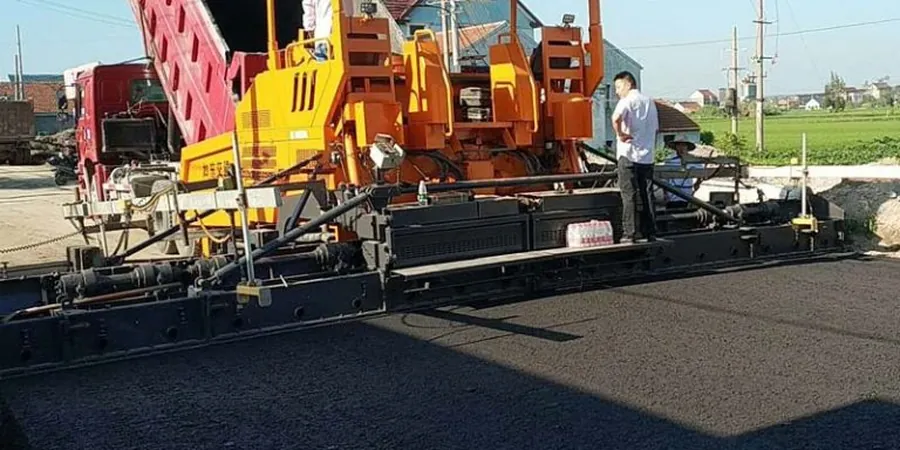
Local considerations
The urban expansion of Niagara Falls Ontario through the 1960s and 1970s pushed residential and commercial development onto agricultural land underlain by the Haldimand clay plain, a glaciolacustrine deposit that is notoriously sensitive to moisture change. Many of those older collector roads were built with minimal granular depth, and today they exhibit classic distress—alligator cracking, rutting, and shoulder drop-off—that traces directly back to inadequate flexible pavement design for the actual subgrade conditions. The risk is compounded by drainage: the escarpment-fed groundwater table rises quickly during spring melt and after heavy rain events, saturating the upper subgrade in a matter of hours. If the pavement structure does not include a positive drainage layer or edge drains, the structural number degrades well below the design assumption. This is not a hypothetical scenario; it is visible every March on roads throughout the region. A flexible pavement design that accounts for these hydrologic realities, using layered elastic analysis and seasonal modulus adjustment, avoids the cycle of patch-and-repair that drains municipal budgets.
Explanatory video
Applicable standards
MTO OPSS 300 (Ontario Provincial Standard Specification for Hot Mix Asphalt), AASHTO Guide for Design of Pavement Structures 1993, ASTM D1883-21 (CBR of Laboratory-Compacted Soils), ASTM D1557-12 (Modified Proctor), CSA A23.1/A23.2 (Concrete Materials and Methods)
Associated technical services
Subgrade Resilient Modulus Testing
Triaxial repeated-load testing following AASHTO T307 to determine the resilient modulus of local soils under varying moisture conditions, providing the essential input for mechanistic-empirical pavement design.
Frost Depth and Drainage Analysis
Site-specific frost penetration modeling using local climate data and soil thermal properties, combined with drainage evaluation to prevent perched water accumulation within the pavement structure.
Structural Number and Layer Optimization
Calibration of the AASHTO 93 structural number for Niagara Peninsula traffic loads, with iterative layer thickness optimization to balance initial cost against 20-year performance targets.
Typical parameters
Frequently asked questions
What is the typical structural section for a flexible pavement in Niagara Falls?
For a heavy-traffic arterial road in Niagara Falls Ontario a typical flexible pavement section includes 180 to 210 mm of hot mix asphalt placed in two or three lifts, over 150 mm of Granular A base and 300 to 450 mm of Granular B subbase. The exact thickness depends on the subgrade resilient modulus and the design ESALs, with structural numbers commonly ranging from 4.5 to 5.8.
How does the Queenston Shale affect pavement design in this area?
Queenston Shale is highly weather-sensitive: when exposed during grading it breaks down into a fine plastic paste that retains water and loses bearing capacity. Pavement design in Niagara Falls Ontario must include at least 300 mm of select subgrade material over the shale and ensure positive cross-fall drainage so water never ponds at the subgrade interface.
What is the cost range for a flexible pavement design package in Niagara Falls?
A complete flexible pavement design package—including subgrade investigation, laboratory CBR and Proctor testing, frost-depth analysis, and structural number calibration—typically ranges from CA$2,450 to CA$6,530 depending on the project length, number of borings required, and traffic data complexity.
Does MTO OPSS 300 require a specific number of asphalt lifts?
MTO OPSS 300 does not prescribe a fixed number of lifts but specifies maximum lift thicknesses based on the mix type. For Superpave 12.5 FC1 or FC2 mixes common in the Niagara region, the maximum compacted lift thickness is generally 60 to 75 mm, meaning a 150 mm asphalt layer requires at least two lifts. This ensures proper compaction and interlayer bonding throughout the pavement depth.