A contractor reached out after hitting organic silt at 3 metres on a hotel expansion near Clifton Hill. The initial plan called for deep foundations, but access was tight and the budget couldn't stretch that far. We ran through the borehole logs and saw an opportunity: the compressible layer was only about 5 metres thick, sitting on competent Queenston shale. Rather than fight the geology, we designed a grid of stone columns to transfer the structural load through the soft zone and into the shale below. In Niagara Falls, the glacial Lake Iroquois deposits create these pockets of low-strength material in places you wouldn't expect, and a well-calibrated ground improvement approach often saves the project. We combine site-specific stratigraphy with CPT testing to map the soft layer thickness precisely before finalizing the stone column layout, and we cross-check performance with SPT drilling where gravel content makes cone refusal likely.
In the layered glacial deposits of the Niagara region, stone columns routinely double the allowable bearing pressure while cutting post-construction settlement by half or more.
Methodology and scope
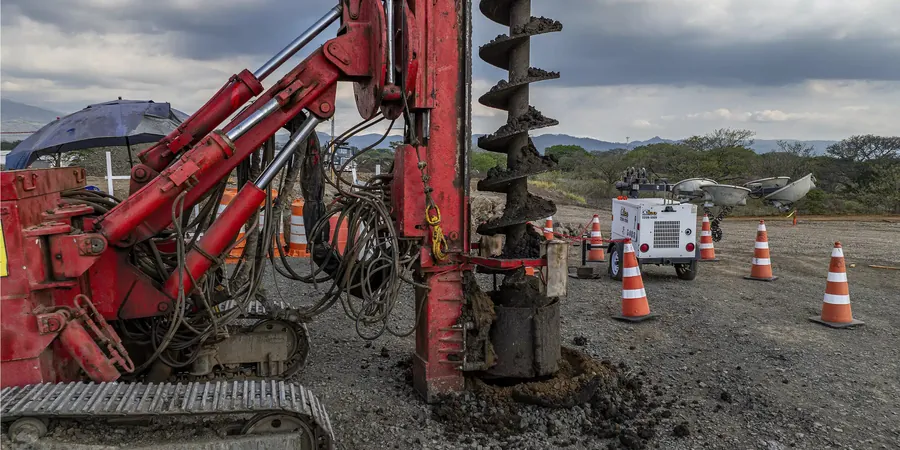
Local considerations
A common mistake we see in the region is treating stone columns as a simple commodity item, ordering a fixed grid pattern without a site-specific design backed by adequate subsurface data. The variable clay content in the Lake Iroquois deposits can reduce the effectiveness of vibro-replacement if the matrix soil does not provide enough lateral confinement during column installation. Without a proper design, you risk excessive bulging near the top of the column under load, which leads to settlement that exceeds the project tolerance. In one case along the Upper Rapids Boulevard, we were called in to diagnose differential movement in a commercial slab where the original design had assumed uniform soil conditions across the building footprint. The fix required supplemental columns in the weaker zones and a load-transfer platform that had not been included in the initial scope. Stone column design in Niagara Falls must integrate the geotechnical model with the structural load distribution, and it should always include a verification program to confirm that the installed columns meet the modulus and density targets.
Applicable standards
NBCC 2020 Part 4 for seismic site classification and foundation design, CSA A23.3 for concrete elements in load-transfer platforms, ASTM D1586 for SPT-based soil characterization prior to design, FHWA-NHI-10-016 for ground improvement design methodology, EBGEO (German Geotechnical Society) recommendations for aggregate pier design in soft soils
Associated technical services
Geotechnical Investigation and Soil Characterization
We execute targeted boreholes, CPT soundings, and laboratory testing on undisturbed samples to define the compressible layer thickness, shear strength, and consolidation properties that govern stone column performance.
Stone Column Design and Layout Optimization
We determine column diameter, length, spacing, and replacement ratio using analytical methods and finite-element models, balancing load transfer, settlement control, and drainage requirements for the specific soil profile.
Post-Installation Verification Testing
We design and supervise modulus load tests, full-scale column load tests, and in-situ density checks to confirm that the installed ground improvement meets the design assumptions and NBCC performance criteria.
Typical parameters
Frequently asked questions
How much does stone column design cost for a project in Niagara Falls?
For sites in the Niagara Falls area, the design package including field investigation, laboratory testing, engineering analysis, and construction drawings typically ranges from CA$1,980 to CA$7,900. The total depends on the building footprint, the number of boreholes required, and whether we need to run time-dependent consolidation analyses for the silty soils common near the gorge.
How long does it take to complete the design and see results on site?
The site investigation and laboratory testing phase usually takes three to four weeks. Design and drafting add another two to three weeks. Once installation begins, the improvement is immediate in terms of densification, though consolidation settlement in the surrounding clay may continue for a few weeks after column installation, which we account for in the settlement predictions.
Do stone columns work in the high groundwater conditions we have near the Niagara River?
Yes, and in fact the vibro-replacement method works well below the water table. The stone backfill is placed from the bottom up, displacing the soil and creating a dense column. The high groundwater in areas like Chippawa or near the hydro canal does not prevent effective column construction, though it does require careful control of the backfill placement to avoid contamination of the stone.
What is the difference between stone columns and deep foundations for a building on soft soil?
Stone columns improve the ground so that the building can be supported on conventional footings or a raft, whereas piles bypass the weak soil entirely and transfer load to rock or a deeper bearing layer. In Niagara Falls, where the Queenston shale is often within 6 to 10 metres, stone columns are frequently more economical than piles because they eliminate the need for structural pile caps and reduce the concrete and steel in the foundation system.