The ground beneath Niagara Falls tells two very different stories. North of the escarpment near Stamford, you hit the Queenston Shale at shallow depth—competent rock that rarely raises liquefaction concerns. But head south into Chippawa or west toward the former Willoughby Marsh, and the profile shifts to loose, saturated sands and silts deposited by glacial Lake Lundy. That contrast is exactly what makes a site-specific soil liquefaction analysis essential here. We routinely see engineers surprised when a site less than two kilometers from bedrock shows cyclic resistance ratios below unity in the upper 6 meters. The 2015 National Building Code of Canada (NBCC) places the region in a moderate seismic zone with a 2% in 50-year spectral acceleration around 0.25g at short periods, yet the lacustrine sand lenses common along the Niagara River corridor can amplify demand beyond what a generic site class would predict. Before committing to a foundation scheme, integrating the borehole data with a seismic microzonation study helps map the lateral variability that makes Niagara Falls geotechnically unpredictable.
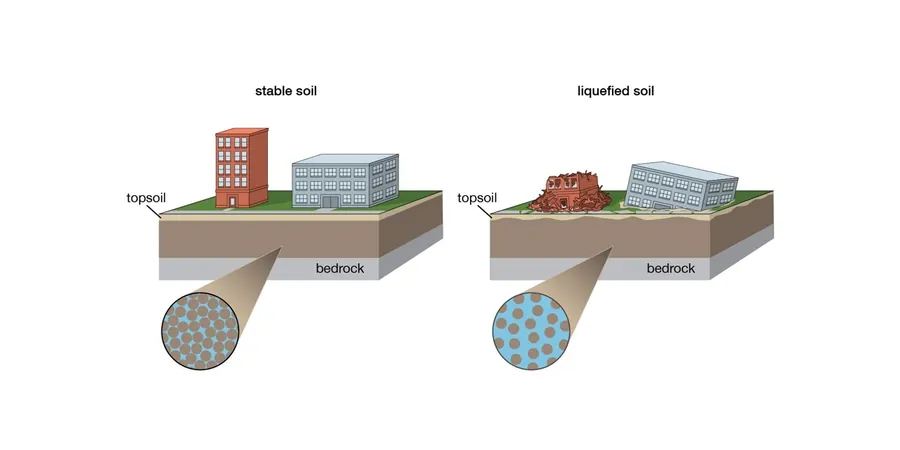
A clean sand with an SPT N-value of 8 at 4-meter depth in a saturated Willoughby profile can generate excess pore pressure ratios exceeding 0.9 under Magnitude 6.5 shaking—post-liquefaction settlement estimates often exceed 40 mm.
Methodology and scope
Local considerations
One thing we see repeatedly in the southeast quadrant of Niagara Falls is that the top 2 meters of fill, often placed during mid-century residential development, completely mask the high-liquefaction-susceptibility silty sand underneath. A contractor who assumes the gravelly surface layer represents the full profile is setting up for a nasty surprise when the ground motion propagates upward and the clean sand at 4 meters loses its effective stress. The consequence is not just settlement—although differential movements of 30 to 50 millimeters can shear utility connections—but lateral spreading toward the free face of the Niagara Gorge or any open excavation. On a recent warehouse project near the QEW, we found a continuous loose sand lens at 5.5 meters that produced a factor of safety of 0.7 under the design earthquake; the solution required targeted vibrocompaction to raise relative density above 70 percent before footing construction could proceed. Ignoring the liquefaction check because the site is on the Canadian Shield margin is a misunderstanding of the overburden geology—the rock is deep enough in the plain that the soil column governs the seismic response entirely.
Explanatory video
Applicable standards
NBCC 2015 – National Building Code of Canada, seismic hazard provisions, NCEER Workshop recommendations (Youd & Idriss 2001) – liquefaction resistance of soils, ASTM D1586-18 – Standard Test Method for Standard Penetration Test (SPT), ASTM D5778-20 – Standard Test Method for Electronic Friction Cone and Piezocone Penetration Testing, CSA A23.3-14 – Design of concrete structures (foundation ductility requirements)
Associated technical services
SPT- and CPT-Based Triggering Analysis
We execute the complete NCEER procedure using corrected field penetration data, compute cyclic stress ratios from the NBCC uniform hazard spectrum, and deliver a factor of safety map for each critical layer. The work includes grain-size correction, age normalization where applicable, and a sensitivity check for the Magnitude Scaling Factor.
Post-Liquefaction Settlement and Lateral Spread Assessment
Beyond the trigger check, we quantify the expected volumetric strain and shear deformation using empirical charts calibrated to the relative density profile. The output is a set of performance-based settlement and displacement estimates that structural engineers can use directly in foundation design and utility routing.
Typical parameters
Frequently asked questions
What is the typical cost range for a soil liquefaction analysis in Niagara Falls Ontario?
A complete liquefaction assessment in the Niagara Falls area, including field drilling with SPT sampling, laboratory grain-size and Atterberg testing, and the NCEER-based analysis report, typically falls between CA$3,300 and CA$5,510. The exact cost depends on the number of boreholes, whether CPT is also required, and the depth of the loose sand layers.
Which zones in Niagara Falls are most susceptible to liquefaction?
The highest susceptibility is in the low-lying areas south of the Niagara Escarpment, particularly the former glacial Lake Lundy plain near Chippawa and Willoughby. Here the overburden includes thick sequences of loose, saturated fine sand and silt with a shallow water table. Sites closer to the gorge or on the escarpment itself have shallow bedrock and generally low risk.
How does the NBCC 2015 seismic hazard affect the liquefaction analysis for Niagara Falls?
The NBCC 2015 defines the peak ground acceleration and spectral ordinates for the site. We extract the short-period (0.2-second) spectral acceleration for the 2% in 50-year hazard level, apply a magnitude scaling factor consistent with the regional seismicity, and compute the cyclic stress ratio for each sublayer. This ensures the analysis matches the code-specified demand rather than a generic value.
Can you perform the analysis if only CPT data is available without SPT?
Yes, we use the Robertson and Wride CPT-based method, which correlates tip resistance and friction ratio to soil behavior type and cyclic resistance ratio. When fines content is uncertain, we may request a few grab samples from adjacent boreholes to calibrate the Ic cutoff, but a CPT-only approach is valid and often faster for screening large sites like industrial parks along the QEW corridor.