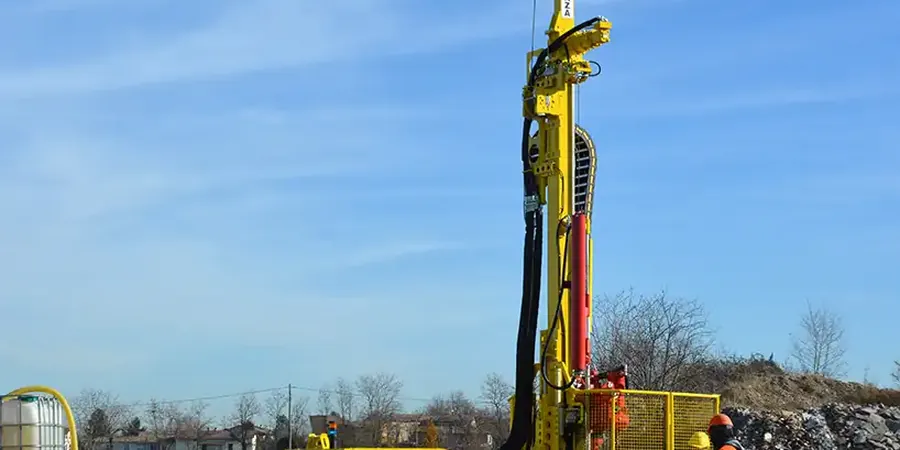
The Niagara Escarpment cuts right through the region, and that means the soil profile can shift from dense Queenston Shale bedrock to soft lacustrine clays within half a kilometer. We run SPT (Standard Penetration Test) programs across Niagara Falls Ontario to give engineers reliable N-values before they commit to a foundation type. The water table sits high in the Chippawa Creek basin — often just 1.5 m below grade — so blow count data collected under wet conditions needs careful interpretation. Our drill crew logs refusal depth, sample recovery, and any drilling fluid loss in real time, because surprises during excavation in this city usually trace back to an unmapped paleochannel or a karst void in the Lockport Dolomite. For projects near the Niagara River gorge, we often pair the SPT drilling with continuous soil profiling to confirm bedrock depth before shoring design begins.
N-value alone is not enough in Niagara Falls Ontario — the glacial stratigraphy here demands cross-checking blow counts with lab classification to catch interbedded silt seams that fail under seepage pressure.
Methodology and scope
Local considerations
The Ontario Building Code (OBC) references NBCC 2015 and CSA A23.3, and both require a site-specific geotechnical investigation when the bearing stratum is variable — which describes most of Niagara Falls Ontario. Skipping SPT testing on a commercial lot near the escarpment edge can lead to differential settlement problems that litigation files are full of. The biggest hazard we flag in our reports is a thin crust of stiff clay over soft silt: the first few SPT blows look promising, then the sampler plunges under its own weight in the next increment. That false refusal scenario is exactly why the test must be carried to full depth. In seismic design category C, which applies to much of the Niagara Peninsula, the NBCC also ties site class determination directly to SPT N-values averaged over the upper 30 m — so shallow tests alone cannot close out the seismic site classification requirement.
Explanatory video
Applicable standards
ASTM D1586-18, NBCC 2015 (National Building Code of Canada), CSA A23.3-14, ASTM D2488 (visual-manual classification, companion to SPT logging)
Associated technical services
SPT Drilling and Sampling
Truck-mounted or track-mounted drill rig with automatic safety hammer; split-spoon samples recovered at 1.5 m intervals or at stratum change, logged by a field engineer on site.
N60 Correction and Energy Measurement
We apply energy ratio corrections using hammer calibration data, plus overburden pressure and rod length corrections, so the reported N60 is directly usable in bearing capacity and liquefaction equations.
Laboratory Classification Package
Split-spoon samples go to our ISO 17025-accredited lab for grain-size distribution (sieve and hydrometer), Atterberg limits, and natural moisture content. Results are paired with SPT logs in a single report.
Typical parameters
Frequently asked questions
How much does an SPT test program cost in Niagara Falls Ontario?
For a typical residential or light commercial investigation with 2-3 boreholes to 10 m depth, the cost ranges from CA$750 to CA$990 per borehole including mobilization, drilling, sampling, and the lab classification package. Deeper holes, difficult access near the gorge slope, or winter drilling with frost penetration will push toward the upper end.
How deep do you need to drill for an SPT in Niagara Falls?
Most projects require 8-15 m depth. Shallow bedrock is common — refusal on Queenston Shale can occur at 3-4 m in the north end — but where glacial Lake Iroquois sediments are thick, we may need 18 m to pass through soft silt and reach competent till. The depth is always confirmed on site based on real-time refusal and sample recovery.
What does the SPT N-value tell my structural engineer?
The N-value is a direct index of penetration resistance. It feeds into bearing capacity calculations, estimates of friction angle for granular soils, undrained shear strength correlations for clays, and liquefaction potential screening. In Niagara Falls Ontario, engineers also use it to decide between spread footings on till versus deep foundations when bedrock is deeper than expected.
How long does it take to get the final report?
Field drilling for 2-3 boreholes is typically completed in one day. Lab testing takes 5-7 business days for grain-size and Atterberg limits. The combined geotechnical report with SPT logs, N60 corrections, lab results, and foundation recommendations is delivered within 10 working days after drilling.