Niagara Falls sits at roughly 170 meters above sea level, but its subsurface story goes much deeper into the Pleistocene. The retreat of the Wisconsinan glacier left behind a complex stratigraphy of Halton Till, glaciolacustrine silts, and Queenston Shale bedrock that varies sharply within a few hundred meters. When a foundation or slope design relies on friction angle and cohesion, generic textbook values are a gamble. Over the years, our team has run triaxial tests on cores from Clifton Hill to Chippawa, and the difference between a consolidated-undrained (CU) test on intact till and a remolded specimen is often the difference between a safe factor of safety and a future failure. Understanding the real effective stress parameters requires a triaxial test program that respects the local depositional history, and we often pair it with a grain-size analysis to confirm the fines content that controls drainage during shear.
A single CIU triaxial test on Queenston Shale fill from a Niagara Falls site gave a friction angle of 22 degrees; remolded at the same density, it dropped to 18 degrees. That gap is the cost of ignoring structure.
Methodology and scope
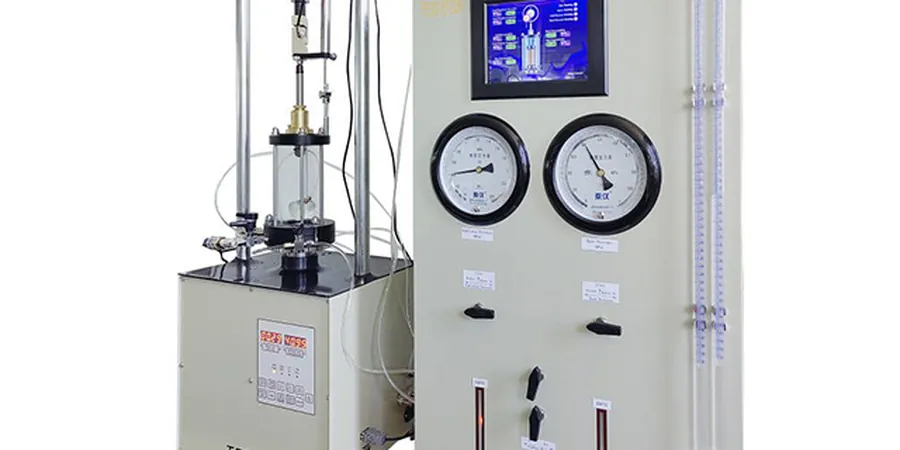
Local considerations
The glaciolacustrine clays that blanket parts of Niagara Falls below the till are prone to strain-softening: once the peak strength is exceeded, the remolded strength can be half or less, a behavior that standard penetration testing cannot capture. In our experience on sites within 500 meters of the Niagara Gorge, the presence of fractured Queenston Shale creates a dual-permeability system where pore pressure dissipation during shear is unpredictable unless measured directly in a CU test with pore pressure transducers. Another risk we encounter frequently is sample disturbance from Shelby tube extraction in sensitive silts; if the tube is hammered instead of pushed, the triaxial result will reflect a disturbed fabric and underestimate the true cohesion intercept. For projects involving deep excavations or retaining walls adjacent to the Welland Canal, we insist on a slope stability analysis that uses triaxial-derived effective stress parameters rather than total stress approximations, because the long-term drained condition governs and the friction angle is your only line of defense against a progressive failure.
Applicable standards
ASTM D4767-11: Standard Test Method for Consolidated Undrained Triaxial Compression Test for Cohesive Soils, ASTM D2850-15: Standard Test Method for Unconsolidated-Undrained Triaxial Compression Test on Cohesive Soils, ASTM D7181-20: Method for Consolidated Drained Triaxial Compression Test for Soils, CSA A23.3 Annex guidelines for foundation bearing resistance from triaxial shear strength, NBCC 2020 seismic provisions referencing soil shear strength for site classification
Associated technical services
CIU Triaxial with Pore Pressure Measurement
Consolidated-Undrained testing on Halton Till and glaciolacustrine clay specimens, measuring excess pore pressure to derive effective stress parameters c' and φ'. Three confining pressures per set, Skempton B-check, and post-shear water content verification.
UU Triaxial for Short-Term Stability
Unconsolidated-Undrained testing for emergency or preliminary assessment of foundation bearing capacity on clay-rich fill. Provides undrained shear strength c_u for total stress analysis when construction timelines are tight.
CD Triaxial for Drained Parameters on Granular Fill
Consolidated-Drained testing on silty sand and shale fill from Niagara Falls sites where long-term drained conditions control retaining wall and slope design. Slow shear rate with volume change measurement for critical-state interpretation.
Typical parameters
Frequently asked questions
How many specimens are needed for a reliable triaxial test program in Niagara Falls?
We typically run three specimens at different confining pressures to define the Mohr-Coulomb envelope properly. For a single borehole in Halton Till, that means a minimum of three CIU tests; if the stratigraphy includes both till and lacustrine clay, you are looking at six specimens total. More if you need to characterize both peak and residual strength.
What is the typical cost range for a triaxial testing program in the Niagara region?
A complete triaxial program including three CIU tests with pore pressure measurement, specimen preparation, saturation, consolidation, shear, and a full interpretive report generally falls between CA$2,270 and CA$3,380 depending on the confining pressure range and whether drained (CD) testing is required for granular layers. Site-specific conditions like sample disturbance or the need for multi-stage testing can shift the final figure.
How do you handle sample disturbance from Shelby tubes in the sensitive silts common near the Welland River?
Sample disturbance is a real issue. We inspect every tube upon arrival and trim away the disturbed ends; the triaxial specimen is carved from the center of the tube where fabric is best preserved. If the recovery ratio is below 90 percent or the tube shows signs of hammering, we flag the specimen and consolidate it to the estimated in-situ stress before shear, but we also note in the report that the peak friction angle may be conservative.